


Key Takeaways
- An advisory team can potentially help enhance the success of a family-owned business and the family members themselves.
- Accountants and corporate lawyers tend to be key team members, but many other types of experts may be involved.
- Introductions from other professionals can be a great way to find advisory team members.
Family businesses are foundational to the development and growth of economies the world over. In the U.S. alone, according to the Small Business Administration, more than one- quarter of firms are family-owned companies—meaning that two or more family members own the majority of the business. What’s more, the 32 million family businesses in the U.S. generate nearly $8 trillion in GDP, according to research by Family Enterprise USA.
They are therefore also instrumental in creating personal wealth for the families who own and operate them. Very often, successful family businesses create large personal fortunes for family members.
That said, this occurs only when family businesses are well managed and grow.
To help ensure effective management and strong but disciplined growth, many family businesses establish advisory teams. These are organized groups of leading professionals who contribute their expertise to help both the family and the company excel.
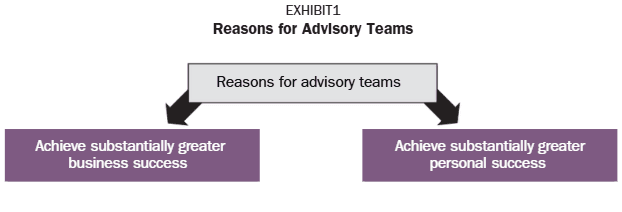
Families put advisory teams in place typically to achieve two key goals for themselves and their businesses (see Exhibit 1):
- Substantially greater business success. Some of the experts on these teams are able to help guide the business forward by enabling the company to avoid obstacles. They often do this by sharing industry best practices and dealing with specific problems the firm faces. The advisory teams are often critical to ensuring the business continues as a family owned and operated enterprise over several generations.
- Substantially greater personal success. There are a few ways advisory teams tend to contribute to the individual success of the family members. One way involves helping family members develop the competencies and business know-how that will enable them to effectively take control of the company down the road. Another way deals with helping individual family members attain greater personal wealth and protect themselves from unfounded lawsuits or marital complications.
We see that formal advisory teams are more common among larger family businesses. When companies have, say, tens of millions of dollars in revenues, they are more likely to systematize their use of top outside professionals by establishing an advisory team— and, in many cases, compensating these experts for their insights and assistance.
That said, many smaller family businesses do rely on various experts for guidance and to act as sounding boards. In effect, these family businesses have an informal advisory team. We tend to find that regardless of the company’s size, as family businesses grow, the need for advice from others becomes greater. When the family business reaches some sort of critical mass, the advisory team often becomes formal and official.
What’s more, the family business advisory teams tend to evolve over time along with the business. As different needs and opportunities arise—brought on by business growth, business challenges and other developments both within the business and in the outside world—family businesses look for insights, direction and solutions from different professionals. At first, that might occur only on an as-needed basis. Over time, some of these professionals may be tapped frequently. When a cohort of specialists is relied on regularly, they’re often formalized into an advisory team.
Key members of an advisory team
There are two types of professionals that almost always end up on family business advisory teams, whether those teams are formal or informal:
- Accountants. The No. 1 most valuable professionals to most family businesses—and nonfamily businesses as well—are accountants. They understand the numbers of the business, and they often understand what can be accomplished to address tax-related issues. Their services are consistently required.
- Corporate lawyers. By and large, the most common type of lawyer on family business advisory teams is the corporate lawyer. From making sure problems are avoided to helping deal with financing, these lawyers are often crucial.
Most likely, the next addition to a family business’s advisory team is their company’s commercial bankers. Because of the (usually ongoing) need for credit, the family business’s commercial bankers are often in the loop. Moreover, their perspective can be very important in directing how to ensure the family business is able to get money when necessary.
Because of their own particular needs and wants, some family businesses add still other types of professionals to their advisory teams. Examples include:
- Family business consultants. Family dynamics have the potential to be disruptive to a family business. Of course, they also can be beneficial. It all depends on the health of those relationships. To enhance the benefits (or mitigate the problems) of a family working together, family business consultants are commonly brought in.
- Executive coaches. Upgrading the knowledge and skills of executives—particularly those who are family members—can often result in a better-running and more successful family business.
- Human resource and compensation specialists. For a family business thawants to bring in nonfamily talent, sourcing skilled executives and getting them to commit to the company can be a challenging task. Developing effective and motivational compensation arrangements for nonfamily senior executives, for instance, can be very important.
- Wealth managers. As family businesses become more successful, wealth managers can prove helpful in assisting family members in making smart decisions about their money. Moreover, wealth managers can be very useful in helping family businesses mitigate certain taxes and build loyalty among key nonfamily employees.
The more any expert is needed, the more likely it is that they will become part of the advisory team. Meanwhile, there are likely to be quite a few other specialists who are engaged only for a specific project—their expertise is not needed regularly. These professionals will likely not be invited onto the advisory team.
Qualities that the team must possess
We find that the best family business advisory teams meet a number of criteria:
- Each professional is exceptionally technically capable. The advice and direction of each expert have to be excellent—after all, the reason you want them involved is because they are very good at what they do, right? Having a track record of success with family businesses is a good indicator.
- Each professional must understand the family business. All the advisory team members must be very familiar with your specific business and industry. Along the same lines, each professional needs to understand your family members beyond a cursory level.
- Each professional has to understand that the advisory team is indeed a team. Some leading professionals are highly convinced of the value they bring to situations but are unwilling to recognize the value that other professionals may also deliver. Put another way, they tend to focus entirely on solutions that are tied to their expertise. But for the advisory team to be effective, there has to be a lot of cooperation among the different experts and a willingness to admit when another expert’s idea is the right one in a given business situation.
Identifying potential advisory team members
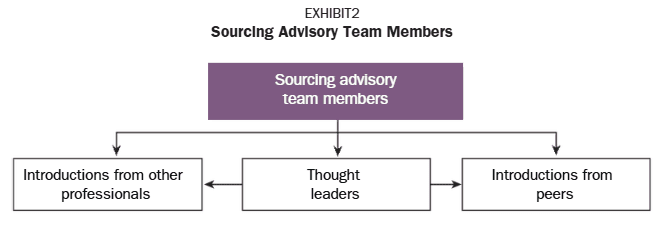
Generally speaking, there are three main ways family businesses find prospective advisory team members (see Exhibit 2):
- Introductions from other professionals. The most pervasive way family businesses find experts is via referrals from current professionals they are engaging and whom they see as highly competent. When issues come up that are beyond an existing professional’s expertise, the family often asks that expert whether they know anyone who can help. This is a very effective way for the family business to mitigate the risk of working with someone unsuitable, because the professional making the referral will only introduce other leading professionals who are exceptional. Otherwise, it could hurt the current professional’s relationship with the family business.
- Introductions from peers. Family businesses also find experts by getting referrals from other family businesses. Very often the family business owners connect because they are in the same industry. When one family business owner asks for recommendations about leading professionals, another family business owner who has dealt with similar issues may introduce the fellow business owner to the experts who made a difference for them.
- Connecting with thought leaders. Everyone wants to work with the best of the best. Thought leaders readily and unreservedly share their insights, processes and best practices with others. Doing so can help a professional become a recognized and heralded expert in their field. Family business owners tend to gravitate to thought leaders because they are usually the best in their fields.
Building on success
Advisory teams can be a powerful way for family businesses to both maintain their success and, more important, continue to become even stronger. Getting the right advisors in place and making sure they work well together may just be one of the key ingredients your company needs in order to move to the next level—and beyond.
VFO Inner Circle Special Report
By John J. Bowen Jr.
© Copyright 2026 by AES Nation, LLC. All rights reserved.
No part of this publication may be reproduced or retransmitted in any form or by any means, including but not limited to electronic, mechanical, photocopying, recording or any information storage retrieval system, without the prior written permission of the publisher. Unauthorized copying may subject violators to criminal penalties as well as liabilities for substantial monetary damages up to $100,000 per infringement, costs and attorneys’ fees.
This publication should not be utilized as a substitute for professional advice in specific situations. If legal, medical, accounting, financial, consulting, coaching or other professional advice is required, the services of the appropriate professional should be sought. Neither the author nor the publisher may be held liable in any way for any interpretation or use of the information in this publication.
The author will make recommendations for solutions for you to explore that are not his own. Any recommendation is always based on the author’s research and experience.
The information contained herein is accurate to the best of the publisher’s and author’s knowledge; however, the publisher and author can accept no responsibility for the accuracy or completeness of such information or for loss or damage caused by any use thereof.
Nathan Brinkman is a registered representative and offers securities and investment advisory services through MML Investors Services, LLC. Member SIPC (www.sipc.org) Supervisory office: 8888 Keystone Crossing #1600, Indianapolis, IN 46240 (317) 469-9999. Triumph Wealth Management, LLC is not a subsidiary or affiliate of MML Investors Services, LLC or its affiliated companies. Nathan Brinkman: CA Insurance License #0C27168 CRN202902-10529820