


Key Takeaways
- Family dynamics can cause issues that flare up when wealth is transferred to heirs.
- Communication is crucial. Tell your heirs your wishes and the reasons behind your estate planning decisions.
- Don’t just document your plan—keep it updated and relevant.
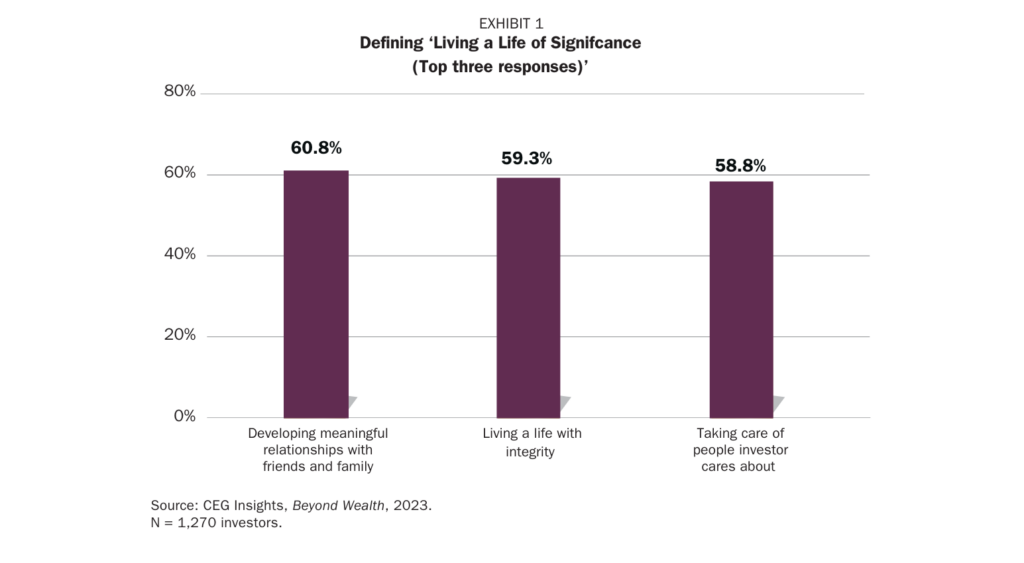
Chances are, you want to pass along some of your property, assets and wealth to your heirs. CEG Insights research finds that nearly 60% of affluent investors say living a life of significance means taking care of the people they value (see Exhibit 1). It’s also likely that you want the wealth transfer process to be smooth, clear and easy—with kids, grandkids and other inheritors walking away pleased.
Trouble is, the opposite outcome occurs too often. When it comes to inheritances, conflicts among family members are common in our experience. The impact of family fights over money can range from small (such as hurt feelings) to massive (including estrangement—with family members never speaking to each other again—and big legal bills that mean a chunk of your wealth ends up in the hands of lawyers instead of heirs).
The upshot: It’s probably a good idea to be thinking about how to arrange your estate planning so it reflects both your wishes for your wealth and any interpersonal family dynamics that could cause big problems down the road.
Sources of family conflict
There are numerous reasons why the death of a loved one might spark infighting about financial matters. Emotions can run high, of course, triggering feelings of uncertainty and stirring up old family resentments. Changes in the family structure—second marriages, stepsiblings and the like—can create suspicion about people’s motives. And financial challenges that family members might be facing can cause people to say and do things they might later regret.
Here are some factors that can contribute to your family fighting about the money or possessions you leave them:
- Your spouse (or partner) is not the parent of your children.
- You have stepchildren or children from multiple marriages.
- You have an estranged adult child or children.
- You don’t approve of an adult child’s partner or spouse.
- You want heirs to co-own certain assets.
- Your children don’t get along with each other.
- You want to leave items to a friend who is not related to you.
- You haven’t explicitly stated which family members you want to inherit specific items or assets.
Nine ways to help avoid estate planning fights
Once you’re deceased, you obviously can’t ensure that your family members won’t fight about the assets you transfer to them (or don’t transfer, as the case may be). But you can make moves today that may help sidestep or minimize the mistrust and anger that could lead to a family feud. Consider these action steps to promote greater family harmony around estate planning.
1. Be aware of—and honest about—existing areas of family tension.
Many people avoid or gloss over conflicts. But chances are you know, for example, whether your kids harbor negative feelings toward your second wife—or whether your daughter has long-standing feelings of resentment toward a sibling. Tensions that have been simmering can quickly boil over when an inheritance enters the picture. If you want to prevent war, think about the current and potential pain points in your family’s various relationships as you start or revise your estate planning efforts, and how you might ease those sore spots.
2. Consider the appropriate balance.
Estate planning can be an opportunity to balance the scales from a family financial perspective. For example, say you’ve given substantial sums to your older child during your lifetime—perhaps for higher education costs or as seed capital to start a business—but given little to no money to your younger child. In that case, you might consider leaving more of an inheritance to the second child and less to the first—particularly if your spending on the older child has caused some family friction. Similarly, if you’ve loaned a child money that you expect to be paid back, consider the math when making decisions about dividing your estate among various beneficiaries.
3. Don’t forget collectibles and heirlooms.
Surprisingly, some of the biggest estate-related family conflicts can arise not over who gets the retirement account assets but over sentimental items with relatively low monetary value. Your kids may have deep emotional attachments to personal items in your home, from an old figurine to an extensive record collection. So decide now who will get which items, and be sure to communicate your decisions to your children. Better yet, ask your kids which (if any) specific items they would most desire.
4. Think through joint ownership.
If multiple heirs want an asset, it’s tempting to leave it to them jointly. However, this attempt at equity might backfire—if, say, the item is difficult or time-consuming to transport from one location to another. Joint ownership of a physical property, such as a lake home, might make more sense but could still result in fights if the various owners have vastly different visions for the property’s future use.
5. Communicate your wishes, intentions and decisions to your heirs.
Many family patriarchs and matriarchs avoid talking about money, particularly inheritances, with the very people that money may impact most. They worry about providing too many details about their finances or fear that they’ll create conflicts by raising the issue of wealth transfer at all. But those conflicts can and do arise regardless.
Best bet: When you have your plan in place, tell your heirs your wishes for the assets and items you’re passing on to them, and the reasons that drove your decisions. They might not agree with what you tell them, but at least they’ll be clear on what you’re doing and why. And you’ll be giving them time to understand how their inheritance will play out and to come to terms with any outcomes they don’t prefer.
6. Consider conducting a family meeting (or two).
Getting everyone together to discuss issues around family wealth can be eye-opening and productive. A formal, facilitated meeting (run by a trusted advisor, for example) can help families better understand their financial goals and wishes, and how estate planning could play a role in them. Often, family meetings result in parents and children better defining their big-picture values around money and what they want to see their wealth accomplish in the world.
7. Choose your trustee carefully.
Parents often appoint one or more children to be the trustee (or co-trustee) of the estate. That can make sense, as a responsible family member can likely be trusted. That said, it may cause friction among siblings who don’t have the powers the trustee has been given. When appointing a trustee, consider hiring an outside professional who is not related to any of the heirs. This type of professional might also be more efficient at navigating the wealth transfer process.
8. Document it all—and keep it fresh.
You likely know you need a will and perhaps one or more types of trusts to accomplish your wealth transfer goals. You can add a letter to your will explaining in your own words your estate planning decisions and wishes.
Just as important as creating wills and trusts is ensuring that they remain relevant and appropriate over time. Life events—births, premature deaths, divorces and so on—could require you to change your estate plan. CEG Insights found that nearly 40% of investors with an estate plan had experienced changes in their life or wealth since designing their initial plan. Revisit these documents with a trusted advisor every few years to determine whether any changes need to be made to a specific document or to your overall plan.
9. Introduce your family members to your advisors.
Another way to smooth the inheritance process is to have your heirs get to know the advisors they’re likely to deal with in the future—which may include your wealth manager, your estate planning attorney or your banker. Doing so gives you the opportunity to demonstrate to heirs your trust in these professionals, allows your heirs to become familiar with them and sets the stage for a smooth working relationship.
Conclusion
Ideally, there will be no drama when the time comes for your wealth to go to your heirs. But the future is uncertain, by definition. By taking some proactive steps now, you could potentially help create a peaceful, conflict-free environment for the people you care about most.
VFO Inner Circle Special Report
By John J. Bowen Jr.
© Copyright 2026 by AES Nation, LLC. All rights reserved.
No part of this publication may be reproduced or retransmitted in any form or by any means, including but not limited to electronic, mechanical, photocopying, recording or any information storage retrieval system, without the prior written permission of the publisher. Unauthorized copying may subject violators to criminal penalties as well as liabilities for substantial monetary damages up to $100,000 per infringement, costs and attorneys’ fees.
This publication should not be utilized as a substitute for professional advice in specific situations. If legal, medical, accounting, financial, consulting, coaching or other professional advice is required, the services of the appropriate professional should be sought. Neither the author nor the publisher may be held liable in any way for any interpretation or use of the information in this publication.
The author will make recommendations for solutions for you to explore that are not his own. Any recommendation is always based on the author’s research and experience.
The information contained herein is accurate to the best of the publisher’s and author’s knowledge; however, the publisher and author can accept no responsibility for the accuracy or completeness of such information or for loss or damage caused by any use thereof.
Nathan Brinkman is a registered representative and offers securities and investment advisory services through MML Investors Services, LLC. Member SIPC (www.sipc.org) Supervisory office: 8888 Keystone Crossing #1600, Indianapolis, IN 46240 (317) 469-9999. Triumph Wealth Management, LLC is not a subsidiary or affiliate of MML Investors Services, LLC or its affiliated companies. Nathan Brinkman: CA Insurance License #0C27168 CRN202908-11755371