


Key Takeaways
- Entrepreneurial businesses are typically small, with fewer than 10 employees.
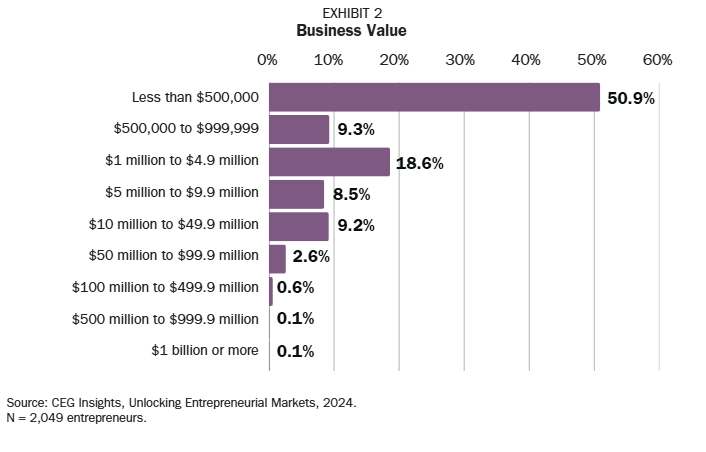
- Nearly one-fifth of entrepreneurs have a business valued between $1 million and $4.9 million.
- More than half of entrepreneurs believe they will significantly exceed their past business growth in the future.
Entrepreneurs often like to measure themselves against their business-owner peers in ways both small (the type of car they drive, say) and large (for example, the percentage of their market that they dominate).
We can’t say with certainty whether it’s a good idea to continually size yourself up relative to others. That’s for you to decide. But we can help you understand some of the key traits, characteristics and attributes of today’s successful entrepreneurs. Armed with such information, you can determine the ways in which you resemble the “typical” business owner (if such a thing exists) and the ways in which you differ from the rest of the pack or even are unique.
You might take those insights and see if they suggest any areas of your operations that you might want to change or improve going forward.
Key findings
In 2024, CEG Insights published its survey of more than 2,000 entrepreneurs from a variety of industries who, collectively, have created some $32 billion in personal wealth. 1
Here are a few of their key findings about today’s business owners:
- Income and net worth. A significant number of entrepreneurs report annual incomes above $249,999, with many earning from $1 million to over $5 million. Similarly, a large group has a net worth ranging from $1 million to over $50 million, including the values of their primary residence and their business.
- Risk tolerance. Over half of the entrepreneurs have an aggressive or highly aggressive risk tolerance, showing a strong inclination for high-return investments despite potential risks.
- Business involvement and sectors. A strong commitment to their ventures is evident, with many entrepreneurs maintaining a high ownership stake and focusing on a single business. Key sectors include finance, insurance, and professional and technical services, suggesting a need for specialized financial advisory services.
- Family engagement in business. Family involvement is notable, especially in the health care, manufacturing and construction industries. This trend is more pronounced among younger entrepreneurs, pointing to the intertwined nature of family and business in entrepreneurial ventures.
- Outlook and self-perception. Entrepreneurs show optimism about future growth, both personally and for their businesses. Many self-identify as innovative or opportunistic, indicating a trend toward seeking new ideas and opportunities, particularly in the manufacturing, retail and real estate sectors.
Let’s explore some of these findings in more detail.
Household income and net worth
One-third (33.2%) of entrepreneurs report an annual household income ranging from $100,000 to $249,999. However, a significant proportion, around 64% of entrepreneurs, earn above this bracket, with a noteworthy 12.3% reporting incomes between $1 million and $2.9 million and 3.4% earning between $3 million and $5 million. Additionally, 4.8% of entrepreneurs exceed the $5 million income threshold annually.
The largest group of entrepreneurs, comprising 25.9%, has a net worth between $1 million and $4.9 million. Notably, those with a net worth of less than $100,000 account for 21.7%, the second-largest category. Meanwhile, high-net-worth individuals with $50 million and above represent a smaller cohort, at 5.3%, highlighting the diversity in the financial standing of entrepreneurs. (Net worth includes their primary residence, the value of their business and their liabilities.)
Business attributes
More than three-quarters (78.2%) of entrepreneurs are dedicated solely to their own businesses, with 67.1% maintaining a 76% to 100% ownership stake, underscoring a robust commitment to their ventures. The majority of entrepreneurs—63.6%—focus on a single business, while 21% have diversified with ownership in two businesses.
Level of involvement
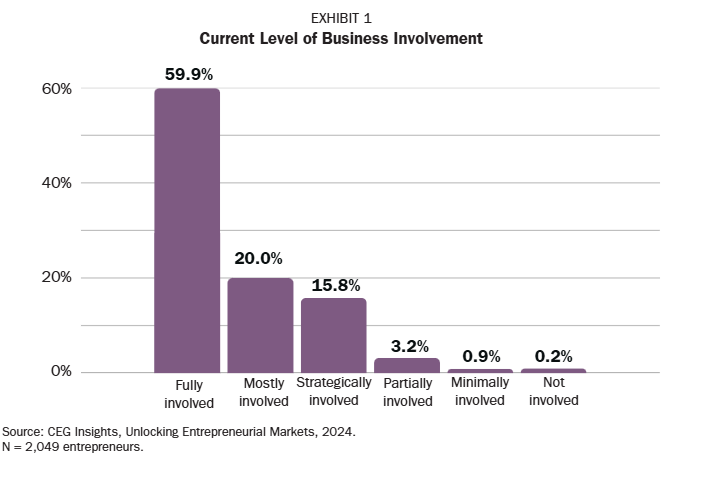
Nearly 60% of the entrepreneurs surveyed are fully immersed in their businesses (see Exhibit 1). A further 20% are mostly involved, indicating significant dedication with some delegation of responsibilities. Strategic involvement is claimed by 15.8%, suggesting a focus on high- level decision-making rather than day-to-day operations. This tiered engagement reflects diverse management styles and varying degrees of operational control.
Interest in new business
A forward-looking 43.8% of entrepreneurs have a keen interest in initiating new enterprises, with younger businesses being hotbeds of this entrepreneurial ambition; owners of operating companies under ten years old show a markedly higher propensity than their counterparts with more mature businesses for starting additional ventures.
Family engagement
There is ample family engagement with entrepreneurial ventures, with 38.5% of entrepreneurs reporting family members as being very involved and 21.2% noting they are somewhat involved. This familial integration is a significant factor in the business operations of entrepreneurs, particularly in the health care, manufacturing and construction industries, where family involvement is high. Looking ahead, entrepreneurs expect sustained family involvement, with 36.5% predicting their family will be very involved in the future.
Business maturity
Most of the entrepreneurs surveyed have relatively mature businesses. Over half (51.7%) of the surveyed businesses fall in the five-to-20-year range, showcasing a considerable segment of established enterprises with a track record of growth and resilience. This suggests that a majority of entrepreneurs are likely beyond the initial startup phase and are managing businesses with some degree of market stability and operational history.
Number of employees
Entrepreneurial companies are predominantly small businesses, with 46.6% having fewer than ten employees. Younger companies, especially those under ten years old, tend to have fewer employees, with the majority having fewer than ten. As companies mature, they tend to employ more workers, with firms over 50 years old having between 26 and 100 employees.
Number of clients
Regarding the size of entrepreneurial client bases, 35.5% of the entrepreneur respondents serve fewer than 100 clients, emphasizing a trend toward specialized and potentially high- value client relationships. A further breakdown by industry reveals that entrepreneurs in professional and technical services are most likely to operate with a lean client list. In contrast, health care entrepreneurs typically cater to a larger customer base, which may reflect the expansive needs of the health care services industry.
Business value
Just over half of the entrepreneurs surveyed (50.9%) have businesses valued at under $500,000, highlighting a significant concentration of smaller enterprises in the cohort (see Exhibit 2). A smaller yet notable segment, 18.6%, have businesses valued between $1 million and $4.9 million. Businesses worth $50 million and above represent a small fraction, accounting for just 3.4% of all businesses.
Business and personal growth
More than half of entrepreneurs believe they will significantly exceed their past business growth in the future. A similar percentage indicates that their personal growth will be similar. Optimism about future growth among entrepreneurs is evident, with 54.3% predicting their personal growth will significantly outstrip their past achievements. This sentiment extends to their business outlook, where 51.2% anticipate their business growth will substantially surpass previous records. Additionally, 32.1% of entrepreneurs expect their personal growth to somewhat exceed their past growth, and 30.5% anticipate their business growth will be somewhat higher than in the past.
In total, confidence in personal and business advancement is robust—with 86.4% of entrepreneurs expecting to exceed their past personal growth and 81.7% holding similar expectations for their business growth. Only 1.7% expect a downturn in personal growth, and just 3.2% foresee a drop in business growth.
Anticipated business involvement
Over half (51.4%) of entrepreneurs intend to remain involved in their businesses indefinitely, eschewing traditional retirement plans. This commitment reflects the broader perspective of more than half of the entrepreneurs, who expect to live longer and envision their enterprises thriving perpetually. This link between entrepreneurs’ life expectancy and their ongoing business involvement underscores the need for dynamic financial planning strategies that support both personal longevity and the enduring success of the business ventures.
Conclusion
Entrepreneurs also have distinct perspectives on topics such as personal goals, health concerns, time management and perceived challenges to the growth of their wealth. These are topics we’ll explore in a future report.
For now, consider some of the key traits of your peers outlined above. Are you involved in your business at the level you prefer? Do you have a sanguine view of the future, or are you worried about the road ahead? And do you have the right number of people—as well as the right people—in place to help you pursue your most important goals?
Knowing where you stand relative to others “in the same boat” may be an important step in ensuring your company is on your chosen path going forward.
1 Source of all data cited in this report: CEG Insights, Unlocking Entrepreneurial Markets, 2024.
VFO Inner Circle Special Report
By John J. Bowen Jr.
© Copyright 2025 by AES Nation, LLC. All rights reserved.
No part of this publication may be reproduced or retransmitted in any form or by any means, including but not limited to electronic, mechanical, photocopying, recording or any information storage retrieval system, without the prior written permission of the publisher. Unauthorized copying may subject violators to criminal penalties as well as liabilities for substantial monetary damages up to $100,000 per infringement, costs and attorneys’ fees.
This publication should not be utilized as a substitute for professional advice in specific situations. If legal, medical, accounting, financial, consulting, coaching or other professional advice is required, the services of the appropriate professional should be sought. Neither the author nor the publisher may be held liable in any way for any interpretation or use of the information in this publication.
The author will make recommendations for solutions for you to explore that are not his own. Any recommendation is always based on the author’s research and experience.
The information contained herein is accurate to the best of the publisher’s and author’s knowledge; however, the publisher and author can accept no responsibility for the accuracy or completeness of such information or for loss or damage caused by any use thereof.
Nathan Brinkman is a registered representative and offers securities and investment advisory services through MML Investors Services, LLC. Member SIPC (www.sipc.org) Supervisory office: 900 E 96th St. Ste 300, Indianapolis, IN 46240 (317) 469-9999. Triumph Wealth Management, LLC is not a subsidiary or affiliate of MML Investors Services, LLC or its affiliated companies. Nathan Brinkman: CA Insurance License #0C27168 CRN202809-9438977