


Many investors spend more time reacting to stock prices than understanding what those prices represent. In a market driven by emotion, momentum, and headlines, the only reliable anchor is the relationship between a company’s price and its intrinsic value. Learning to mind that gap can materially improve your returns. Warren Buffett famously quipped “price is what you pay; value is what you get.” Before buying a stock, know what you are getting.
Investors love good stories. They love stocks with strong sentiment and upside is “the moon”. Yet, smart investors know that stock market wealth rests on a simple, immutable truth: A business is worth the cash it can generate over its lifetime, discounted back to today. Investors can use a discounted cash flow model, although many simply use price-to-earnings ratios as a shortcut to estimate value.
Once you establish a business’s value, you can focus on the price-value relationship, illustrated in the chart below. This chart is your North Star. It holds some of the most important lessons in all of investing. It offers a visual roadmap for expected returns, where a widening gap represents increased opportunity. It shows why a good company may not always be a worthwhile investment — and why investing is more about the price you pay than anything else. You quickly realize the relationship between price and value drives expected returns. Everything becomes a value proposition, not a beauty contest.
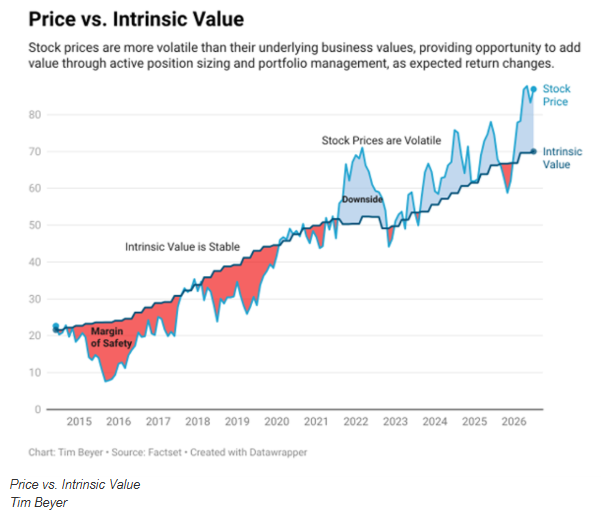
Here are ten key takeaways from this chart:
Price Moves More Than Value
Price is more volatile than the underlying business value. Famed investor Howard Marks compares this dynamic to a pendulum, with the stock price swinging above and below fair value but rarely sitting at fair value. While short-term volatility is typically used as a measure of risk, value investors welcome it because it creates opportunity. Company fundamentals are far more resilient and less volatile than their stock prices imply.
Sentiment Drives Price in the Short Run
While a company’s intrinsic value drives its stock price in the long run, it has little bearing on price in the short run, when it is primarily driven by sentiment — an emotional tug of war between fear and greed. Ben Graham explained this with an allegory, starring a man suffering from extreme mood swings, named Mr. Market. When Mr. Market feels optimistic, he offers outrageously high prices for your shares. When he feels depressed, he offers his shares at fire-sale prices. He does not care about the company’s inherent value or its long-term outlook; he is driven by emotion and a poor temperament ill-fit for investing.
If you are a levelheaded investor with a long time horizon, short-term volatility is an opportunity, not a risk.
Value Drives Price in the Long Run
While sentiment drives stock prices in the short run, the value of the business drives the stock price in the long run. Estimating the value of a business is far easier than estimating investor sentiment, which is why many investors favor long-term investing over short-term trading. If you can accurately estimate a company’s value, buy when the price offers a large margin-of-safety, and remain patient, you can generate outsized returns when price and value converge.
Price and Value Dictate Expected Return
Price is the inverse of expected return. All else equal, when a stock’s price goes up, expected return goes down. Investors should adjust position size accordingly as expected return changes — buying when prices fall and selling as prices rise.
Stocks Can Stay Overvalued or Undervalued for Years
The market’s recognition of value often takes time. The market doesn’t know or care that you own the stock. Sitting in a perpetually undervalued stock for years is painful and can lead to behavioral errors, like capitulating from fatigue. Investing requires patience, which is often rewarded as price and value tend to converge over time.
Market recognition of value typically requires a catalyst, like a positive earnings report, a new product or a change in management. Some value investors demand a catalyst, calling their approach “value plus a catalyst.” They don’t want to sit in “dead money” waiting indefinitely for price and value to converge. The wrinkle: If you identify a catalyst, it is likely already reflected in the stock price.
Sometimes value is its own catalyst. If management can’t realize the value of the business, or the market refuses to acknowledge it, the collective market eventually does it for them — through, for example, a private equity takeout, a strategic acquiror, activists involvement, or a forced breakup.
Total Return Comes from Growth and Margin of Safety
You can achieve equity returns two ways:
1) Growth in the value of the business, usually through earnings growth.
2) Closing the price-value gap, often referred to as the margin-of-safety.
Optimally, you want to own stocks with both — growing companies trading at significant discounts to value.
Intrinsic Value Grows Over Time
Intrinsic value typically grows over time, although this varies by company. It is driven primarily by the company’s EPS growth rate and capital allocation policy. As a base rate, the S&P grows earnings approximately 6% a year, in line with historical nominal GDP growth. Adding 2-3% growth from share repurchases leads to around 8-9% earnings per share growth for the S&P, on average and over time. This acts as a tailwind to the growth in the value of businesses over time.
Margin of Safety Alone Can Drive Returns
Just as growth can drive returns even if the valuation discount remains, closing the margin-of-safety gap alone can also provide attractive returns. While it is preferable to own businesses with attractive growth profiles, you can generate strong returns without growth if the stock is cheap enough. Thus the investing maxim, “There are no bad assets, just bad prices.”
The Margin of Safety Principle Helps Limit Losses
Buying stocks with a large margin-of-safety at time of purchase helps minimize risk of loss. It tells you how much the value of the business can decline before you experience a loss — or alternatively, it tells you the upside expected return. As the stock’s value and price change, expected return changes. Managing position size around expected return can add value to your equity portfolio.
Buy on Strength, Sell on Weakness
Price and expected return have an inverse relationship, which should lead investors to sell winners as their prices rise and the expected return falls, and buy more of their losers as their prices fall and the expected return rises, holding everything equal. This runs counter to the common sayings “cut your weeds and water your flowers”, “let your winners ride” or “never interrupt compounding.”
Investing is based on expected returns. When stocks go up expected return goes down, making selling a rational decision rather than an emotional one. Many investors do not follow this logic, believing they should hold winners even though expected return has worsened as the price has risen.
More than any other investment strategy, value investing — that is, investing based on the difference between price and value — remains one of the most logical, rational, and intuitive approach to investing. As Joel Greenblatt once warned, “Choosing individual stocks without any idea of what you’re looking for is like running through a dynamite factory with a burning match. You may live, but you’re still an idiot”. Pick your investment discipline carefully.
By Timothy P. Beyer, CFA, Contributor
July 28, 2026
© 2026 Forbes Media LLC. All Rights Reserved
This Forbes article was legally licensed through AdvisorStream.
Information from third parties may be proprietary, privileged and/or confidential, any use, copying, retention or disclosure is strictly prohibited. Securities and investment advisory services offered through qualified registered representatives of MML Investors Services, LLC, Member SIPC. The views and opinions expressed are those of the author(s) and may not accurately reflect those of MML Investors Services, or its affiliated companies. Local firms are sales offices of Massachusetts Mutual Life Insurance Company (MassMutual), and are not subsidiaries or affiliates of MassMutual, MML Investors Services, or their affiliated companies.
Nathan Brinkman is a registered representative and offers securities and investment advisory services through MML Investors Services, LLC. Member SIPC (www.sipc.org) Supervisory office: 8888 Keystone Crossing #1600, Indianapolis, IN 46240 (317) 469-9999. Triumph Wealth Management, LLC is not a subsidiary or affiliate of MML Investors Services, LLC or its affiliated companies. Nathan Brinkman: CA Insurance License #0C27168