


Summary
Many investors are holding record cash reserves, totaling $7.93 trillion, despite the S&P 500 reaching new highs, driven by market timing fears. However, studies by Schwab, J.P. Morgan, and Vanguard indicate that staying out of the market poses the greatest risk. Even consistently buying at market peaks historically yields significantly better returns than holding cash. Record highs are not deterrents; investing on such days has often been profitable. The method of investment, whether lump sum or dollar-cost averaging, is less crucial than simply getting invested. To overcome fear, the article advises a structured approach: rehearse worst-case scenarios (premortem) to understand potential downturns and recovery times, especially with a balanced portfolio. Then, create a written plan, automate investments, and establish safeguards with partners or advisors to prevent impulsive selling during volatility. The core message is to plan, commit, and get invested, as the "cold pool" of the market is always worth entering.
You’ve got a chunk of cash in your portfolio. Maybe you sold a business, received a bonus or inherited a pile. Maybe you pulled out of the market to get defensive and never got back in. Meanwhile, the S&P 500 has set 27 record closing highs so far this year.
You’re not alone. Money market funds now hold $7.93 trillion, a record, according to the Investment Company Institute.
What should you do?
Here’s a framework that satisfies both the head and the heart.
Standing On The Deck
Imagine standing on the deck of a pool. The water is cold. You can jump in at once, wade in gradually or wait for the water to warm. When is the best time to get in the pool?
Charles Schwab published a study in 2025, “Does Market Timing Work?”, in which five hypothetical investors were given $2,000 a year to invest over a 20-year period ending 2024. The perfect timer, who bought at the exact low every single year, ended with $186,077. The investor who put the money in immediately on the first trading day each year, no timing at all, ended with $170,555. The investor who divided his money into 12 monthly purchases ended with $166,591. The unluckiest investor, who bought at the exact peak every year for 20 straight years, still ended with $151,343. The investor who stayed in cash ended with $47,357.
Staying out of the pool created the biggest risk. That overwhelmed any timing decision.
Record Highs Aren’t Red Flags
J.P. Morgan Asset Management found that since 1950, roughly 7% of trading days closed at a new all-time high, and nearly a third of those highs became floors the market never fell more than 5% below again. Since 1988, investing only on record-high days produced an average one-year return of 14.3%, versus 11.9% for any random day.
Schwab’s research finds the market rises 75.6% of the time in a typical 12-month period. Avoiding highs means avoiding the market.
Should You Wade in or Take the Plunge?
By the numbers, it matters less than you think. Vanguard found that investing a lump sum immediately beat spreading it over three months about 68% of the time from 1976 through 2022. Morgan Stanley’s Global Investment Office, testing diversified portfolios, found the same result with a smaller edge, at most 0.42% a year for its most aggressive portfolio.
The method of getting invested isn’t the key decision. The data shows the decision that really matters is simply to get invested.
Transform the Decision from Timing to a Plan
Instead of treating this as a one-time timing decision, create your investing program. A physician friend puts it this way: He can prescribe the perfect prevention protocol, but if the patient won’t follow it, the protocol is worthless. The best program is the one you can stick with. Investing works the same way. Which is why we must address both the rational (head) and the emotional (heart).
Rehearse The Worst
The Stoics had a tool for this. Seneca called it premeditatio malorum, the premeditation of evils: imagine the worst vividly, in advance, so it loses the power to ambush you. Modern decision science rebuilt the tool and named it the premortem.
Run this thought experiment. You invest tomorrow, and the worst stretch in modern memory repeats. What actually happens to you? Morningstar’s 150-year study of market crashes, built on data compiled by Paul Kaplan, lets you rehearse with real numbers. All figures are adjusted for inflation.
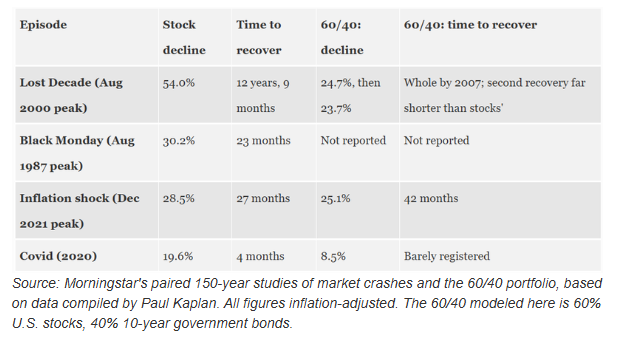
The Lost Decade is what keeps people on the sidelines: If you had the bad luck to buy the top in August 2000, an all-stock portfolio sat underwater for 12 years and nine months. A balanced investor had shallower drawdowns and generally recovered faster, with one exception. It took the worst bond market in history to produce it, but 2022 was the only episode in 150 years where the balanced portfolio stayed underwater longer than stocks, 42 months against 27. Even then, its decline never ran deeper.
The table models a single sum invested once. If you’re still saving and adding, you bought through those declines at falling prices and your personal breakeven arrived earlier.
Now the personal half of the rehearsal. Imagine you invested your cash today and one of these scenarios repeated. Are you able to stick with your long-term investing plan? What would cause you to deviate? A job loss? A health scare? How likely is this worst case to happen? A crash alone rarely forces anyone to sell at the bottom. A crash plus needing the money does.
Taming Uncertainty to Get Off the Sidelines
The premortem, living the worst-case scenario and assigning a probability to it, helps tame uncertainty by pre-planning your actions. It also helps you determine whether you should jump into the deep end with an aggressive allocation or move to shallower water.
Once you’ve run the rehearsal, here’s how to move from thinking to doing.
First, if you have a life partner, do the premortem together. This isn’t a financial planning exercise. It’s a conversation about what you’d actually do if the worst happened. Get aligned on the deck, not in the water.
Second, write your plan down. Your allocation. Your investing schedule. The specific actions you’ll take if the market drops 20%, 30%, 40%. Writing it makes it real. It also gives you something to return to when fear is loudest and memory is least reliable.
Third, automate everything you can. If you decide to dollar-cost average, set it up as an automatic transfer and remove yourself from the execution. The goal is to make the plan self-running, so that staying the course requires no decision at all. Decisions are where fear gets in.
Fourth, make it structurally difficult to deviate. This is what the ancient Greeks understood when Odysseus had himself lashed to the mast before sailing past the Sirens. He knew the music would be irresistible. So he removed his own ability to act on the impulse. Automation handles the execution. This step handles the panic. Give your financial advisor a standing request in writing: If I call wanting to sell, walk me back through the plan we wrote and ask me to wait 48 hours.
If you have a life partner, have a specific conversation now, while the water is calm: If I come to you wanting to sell, your job is to slow me down. Not to agree with me. If you invest on your own and don’t have a life partner, you can make the same arrangement with a trusted friend. The Sirens will sing. You’ve already decided not to listen, and you’ve made it hard to change your mind.
Get in the Pool
You’ve rehearsed the worst and decided you can live with it. You’ve written the plan, automated the execution and told someone what you’re going to do. There’s nothing left to decide.
The pool is cold. It always is. Plan accordingly.
By Scott Lavelle, Contributor
Aug. 25, 2026
© 2026 Forbes Media LLC. All Rights Reserved
This Forbes article was legally licensed through AdvisorStream.
Information from third parties may be proprietary, privileged and/or confidential, any use, copying, retention or disclosure is strictly prohibited. Securities and investment advisory services offered through qualified registered representatives of MML Investors Services, LLC, Member SIPC. The views and opinions expressed are those of the author(s) and may not accurately reflect those of MML Investors Services, or its affiliated companies. Local firms are sales offices of Massachusetts Mutual Life Insurance Company (MassMutual), and are not subsidiaries or affiliates of MassMutual, MML Investors Services, or their affiliated companies. Nathan Brinkman is a registered representative and offers securities and investment advisory services through MML Investors Services, LLC. Member SIPC (www.sipc.org) Supervisory office: 8888 Keystone Crossing #1600, Indianapolis, IN 46240 (317) 469-9999. Triumph Wealth Management, LLC is not a subsidiary or affiliate of MML Investors Services, LLC or its affiliated companies. Nathan Brinkman: CA Insurance License #0C27168