

Key Takeaways
- Many of the wealthiest investors use social media to connect with their advisors and get financial information.
- Social media influencers are impacting some investors’ decision-making process.
- Slow down and think critically about any “facts”—financial or otherwise—that you see on social media.
Social media has become a key part of many people’s daily lives. Facebook, Instagram, TikTok and other online outlets are now go-to resources for gathering information, keeping up with friends and family, and finding community among like-minded people and groups.
Therefore, it probably shouldn’t come as a surprise that social media is playing a growing role in how many of us make decisions about wealth. Here’s a look at how affluent investors are incorporating social media into their lives—along with some advice about using social media in productive and healthy ways.
The ultra-wealthy’s use of social media
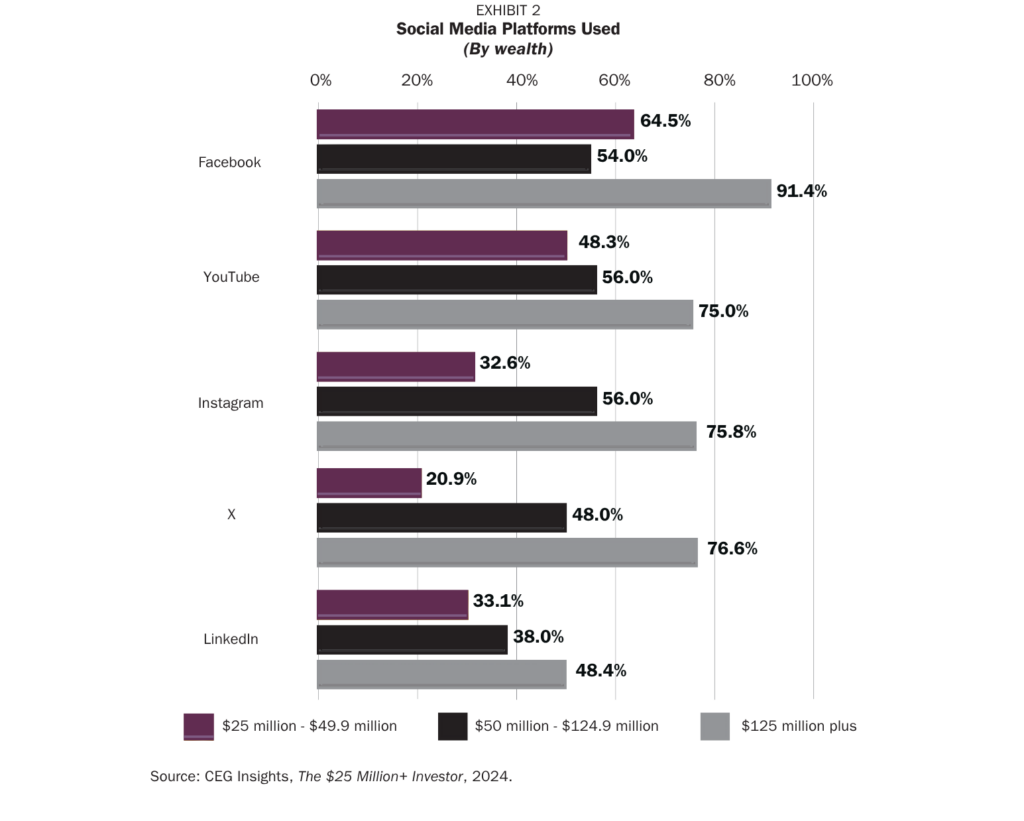
Social media is popular among some of the wealthiest investors. For example, CEG Insights found that among the ultra-wealthy (those with a net worth of $25 million or more, excluding primary residence):
- 72.9% use Facebook
- 59.1% use YouTube
- 51.7% use Instagram
- 45.1% use X
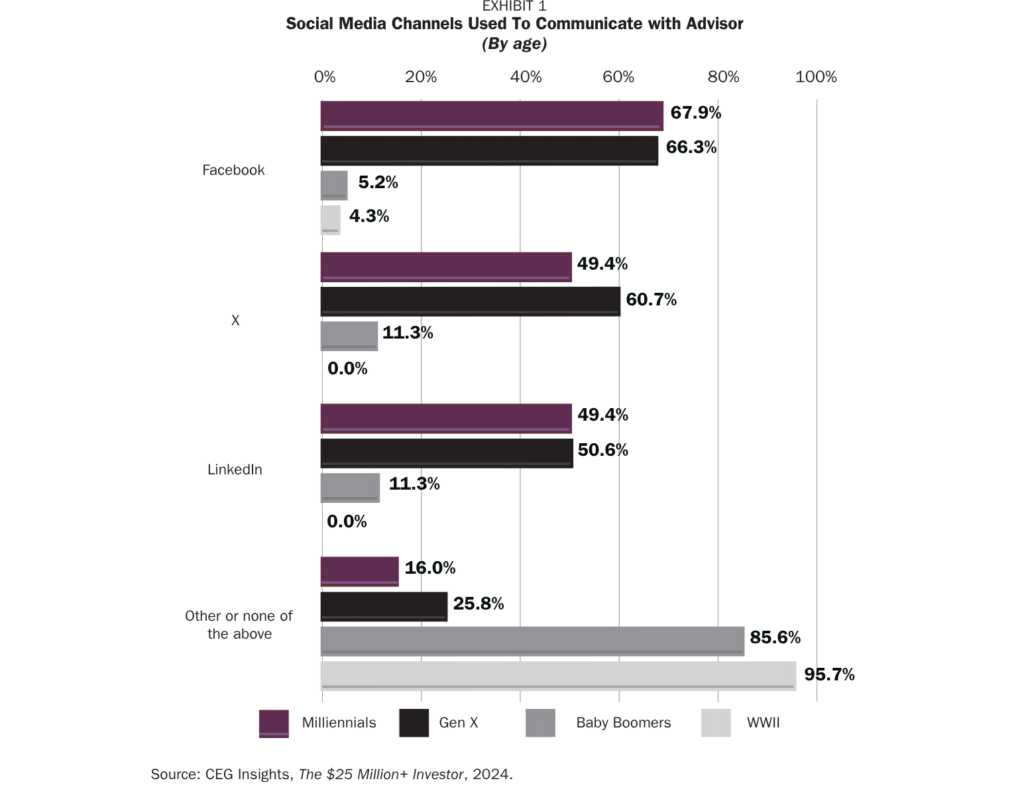
What’s more, social media and wealth management are connected for many of these investors. For example, more than 40% of the ultra-wealthy surveyed by CEG Insights use Facebook to communicate with their advisors. Approximately one-third of these investors use X and LinkedIn for such communication.
These social media channels are particularly valuable to younger generations. More than 60% of ultra-wealthy Gen X investors use X, and a similar percentage use Facebook. Almost half of ultra-wealthy Millennials use X to communicate with their advisor, and two-thirds use Facebook. In contrast, Baby Boomers and the WWII Generation largely steer clear of social media (see Exhibit 1).
Social media is also disproportionately popular among the very wealthiest investors. Those individuals with a net worth of at least $125 million are more likely than their less-wealthy ultra-affluent peers to use virtually all types of social media channels (see Exhibit 2).
Social media’s effect on financial decision-making
But social media’s role in managing wealth goes beyond mere communication with advisors. Exhibit 3 shows that ultra-wealthy members of Gen Z are just as likely to get their financial information from social media as they are from advisors. Meanwhile, more than one-third of ultra-wealthy Millennials use social media as a source for financial information.
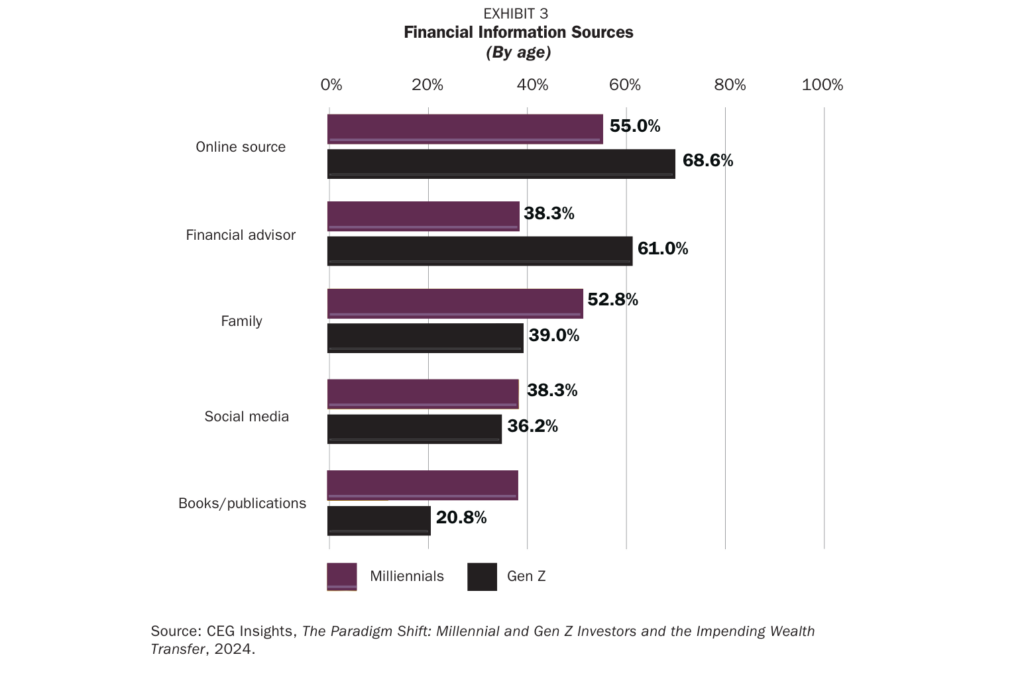
Additionally, more than half of Millennials and Gen Zers follow financial social media influencers—or “fin-fluencers.”
The result: Social media is often influencing the decisions these investors ultimately make. Consider:
- More than 60% of ultra-wealthy Gen Zers say that social media has at least some impact on their financial decisions. More than half of ultra-wealthy Millennials agree.
- Around 80% of both groups say social media influencers do, in fact, influence their financial decisions to some extent.
Negative impacts
Worldwide, adults spend an average of almost 2.5 hours a day on social media, according to the World Economic Forum. Like anyone else using social media, investors need to be careful that they don’t suffer from mental health-related issues associated with online activity.
For instance, one review out of Singapore of more than 114 studies on social media usage among adults found that 78.6% of the studies found negative impacts of social media use on mental health and well-being—including depression, anxiety and loneliness.
On the other hand, getting off social media can have almost-immediate mental health benefits. One example: In a U.K. study published in Cyberpsychology, Behavior, and Social Networking, people ages 18 to 72 who used social media every day were told to either stop using all social media for a week or continue using it as usual. Those who took a break for a mere seven days had significant improvements in well-being, depression and anxiety compared with those who continued to use social media.
In short, it’s not just our kids and grandkids we need to worry about when it comes to social media usage; it’s ourselves, too.
Smarter ways to social
So how can you use social media responsibly, in a way that keeps you sane? Consider these strategies:
Additionally, more than half of Millennials and Gen Zers follow financial social media influencers—or “fin-fluencers.”
The result: Social media is often influencing the decisions these investors ultimately make. Consider:
- More than 60% of ultra-wealthy Gen Zers say that social media has at least some impact on their financial decisions. More than half of ultra-wealthy Millennials agree.
- Around 80% of both groups say social media influencers do, in fact, influence their financial decisions to some extent.
Negative impacts
Worldwide, adults spend an average of almost 2.5 hours a day on social media, according to the World Economic Forum. Like anyone else using social media, investors need to be careful that they don’t suffer from mental health-related issues associated with online activity.
For instance, one review out of Singapore of more than 114 studies on social media usage among adults found that 78.6% of the studies found negative impacts of social media use on mental health and well-being—including depression, anxiety and loneliness.
On the other hand, getting off social media can have almost-immediate mental health benefits. One example: In a U.K. study published in Cyberpsychology, Behavior, and Social Networking, people ages 18 to 72 who used social media every day were told to either stop using all social media for a week or continue using it as usual. Those who took a break for a mere seven days had significant improvements in well-being, depression and anxiety compared with those who continued to use social media.
In short, it’s not just our kids and grandkids we need to worry about when it comes to social media usage; it’s ourselves, too.
Smarter ways to social
So how can you use social media responsibly, in a way that keeps you sane? Consider these strategies:
1. Set limits and stick to them.
Think of social media a bit like junk food. Chances are, you don’t mindlessly eat chips from a bag for hours at a time—instead, you put a portion of them in a bowl. Similarly, allocate a limited window or two of time each day when you check in on your social media accounts.
Yes, you’ll need willpower to stay within those self-imposed limits, just as you do when you wait until after dinner but before 10:00 p.m. to reach for the ice cream. But you can also get some help here, thanks to a wide array of apps and browser extensions that block or limit access to social media sites according to parameters that you can personalize. (Better yet, have someone else set up those parameters so you can’t change them on a whim.)
You can also silence notifications from whatever platforms you visit most often, to remove the constant intrusion of tempting new alerts. Finally, leave the cellphone downstairs when you go to bed so it’s not the first thing you reach for in the morning.
2. Slow down and think critically about what you see on the screen.
It’s easy—and fun—to rapidly scroll through news headlines and other information online and simply take it all in as facts. But given how much disinformation there is today, it’s crucial to be skeptical and take what you see with a big chunk of salt.
It’s important to keep a healthy perspective on anything you see on the web—such as those pics of the deliriously happy-looking family next door enjoying yet another island vacation, or stories of “meme stock” millionaires. Remember that people often curate their online image—presenting only the amazing moments and never even mentioning the struggles they (like all of us) have.
3. Cultivate your offline best self.
One of the biggest benefits of social media has been to help people with niche hobbies connect with others who share their interests. You know where else you can do that? In the real world! If you think you’re spending too much time online, try getting out there and making a concerted effort to meet up with people in real life.
When you’re not spending time online, weave in some movement or activities that are tangible and tactile. The American Cancer Society followed 140,000 older adults and reported that those who walked a mere six hours per week had a lower risk of dying from cardiovascular disease, respiratory disease and cancer than those who were not active.
4. Check fin-fluencers’ credentials.
Do the fin-fluencers you encounter on social media have the required expertise to be holding court on the topics they’re discussing, or are they “just regular people” using their “common sense”? This is a crucial question to ask yourself if they’re doling out advice or making specific investment recommendations.
Of course, even professionals with great expertise can make mistakes—but having a strong foundation of financial knowledge can make those mistakes less likely to occur.
Note: Some fin-fluencers will talk about their “industry experience” in vague terms. Dig deeper: Were they a financial analyst—or did they work in a call center? If they claim to hold a financial designation, check that it’s from a reputable organization.
5. Watch for red-flag words and phrases.
Promptly ignore any fin-fluencer throwing out terms like “guaranteed,” “can’t lose” or “a surefire winner.” The future direction of investments can’t be predicted with such certainty, so anyone who tells you they know what the future holds is lying. Similarly, watch out if the person creates a big sense of urgency—noting, for instance, that you need to buy a product or service right now or you’ll miss the opportunity. Another red flag: The fin-fluencer trash-talks “mainstream” professionals such as advisors or accountants and claims to be the one with the “real” insights you won’t get anywhere but this person’s YouTube videos.
6. Get help if you need it.
Breaking social media addiction can be a big challenge—and not just for kids. If you’ve tried some of the strategies discussed here and still fear your time spent on social media feeds is having a deleterious effect on your health, seek some professional help. A new cottage industry has sprung up in recent years: therapists and counselors who specialize in helping patients manage the mental health aspects of social media overuse and the adverse effects it can cause.
Ultimately, Pandora’s Box is open and can’t be closed. It’s pretty much guaranteed that we’ll be living with social media in some form or another for the rest of our lives. But how you interact with it, and how it benefits or damages your health, is largely in your control.
VFO Inner Circle Special Report
By John J. Bowen Jr.
© Copyright 2026 by AES Nation, LLC. All rights reserved.
No part of this publication may be reproduced or retransmitted in any form or by any means, including but not limited to electronic, mechanical, photocopying, recording or any information storage retrieval system, without the prior written permission of the publisher. Unauthorized copying may subject violators to criminal penalties as well as liabilities for substantial monetary damages up to $100,000 per infringement, costs and attorneys’ fees.
This publication should not be utilized as a substitute for professional advice in specific situations. If legal, medical, accounting, financial, consulting, coaching or other professional advice is required, the services of the appropriate professional should be sought. Neither the author nor the publisher may be held liable in any way for any interpretation or use of the information in this publication.
The author will make recommendations for solutions for you to explore that are not his own. Any recommendation is always based on the author’s research and experience.
The information contained herein is accurate to the best of the publisher’s and author’s knowledge; however, the publisher and author can accept no responsibility for the accuracy or completeness of such information or for loss or damage caused by any use thereof.
Nathan Brinkman is a registered representative and offers securities and investment advisory services through MML Investors Services, LLC. Member SIPC (www.sipc.org) Supervisory office: 8888 Keystone Crossing #1600, Indianapolis, IN 46240 (317) 469-9999. Triumph Wealth Management, LLC is not a subsidiary or affiliate of MML Investors Services, LLC or its affiliated companies. Nathan Brinkman: CA Insurance License #0C27168 CRN202908-11385499