


Key Takeaways
- Top entrepreneurs tend to rely on referrals to find their financial advisors.
- Many business owners are self-directed in making financial decisions—but want their advisors to offer reality checks.
- Consider whether you prefer using one advisor or multiple advisors.
Successful entrepreneurs often rely on a variety of financial professionals to help them manage their businesses and their personal wealth. Such experts can be valuable resources and sounding boards when it comes to mitigating financial risks, identifying (and positioning to capture) financial opportunities and preserving the wealth that business owners have worked hard to build.
If you’re reading this, chances are you work with one or more professionals who advise you on business and money matters. But are you getting what you want and need from those professionals? And if you’re searching for new or additional resources, what are some selection factors that you might consider?
To answer such questions, CEG Insights surveyed 2,049 entrepreneurs from a variety of industries and published the findings in its 2024 report Unlocking Entrepreneurial Markets. The findings offer important insights into business owners’ experiences with—and attitudes about—financial advisors. This information may help you better assess your existing advisor relationships and think about what matters most to you as you work with financial professionals who can potentially improve your outcomes.
Entrepreneurs’ perception of value
Exhibit 1 shows that entrepreneurs overall indicated that trustworthiness and expertise are, far and away, the most valued features of their primary financial advisors—with trustworthiness just slightly more valued (62.4%) than expertise (60.6%). Personalized service and strong advisor-client communication were cited as top traits by more than 40% of business owners. Financial advisors’ comprehensive planning and proactive approach were most valued by around one-third of entrepreneurs.
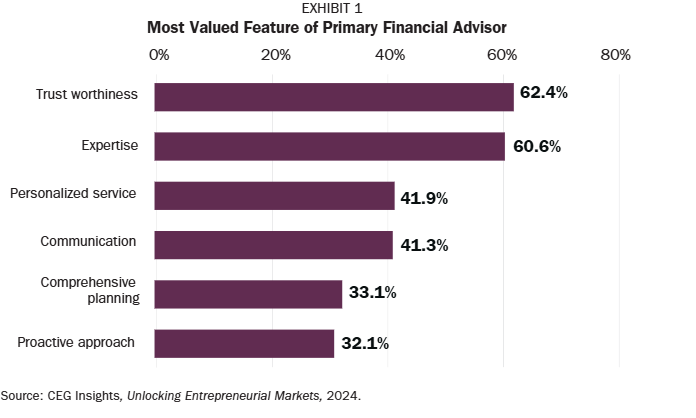
When focusing on entrepreneurs with $5 million or more in net worth, expert advice is the primary expectation (60.4%), while trust and transparency (47.3%) actually ranks lower than personalized service (48.5%). So while all entrepreneurs value trust, the higher-net-worth individuals appear to place a slightly greater emphasis on the quality of the advice they get.
Nearly half of these entrepreneurs value personalized service (48.5%), showing a clear preference for advisors who tailor their strategies to individual needs. Proactive communication is also a key factor for 46.9% of the $5 million-plus entrepreneurs, signifying the importance they place on advisors’ initiating discussions and anticipating needs.
The similarity among both of these groups of entrepreneurs in prioritizing expert advice indicates universal respect for knowledge, whereas the difference in the value placed on trust and transparency hints at varying expectations based on an entrepreneur’s net worth—possibly due to the complexity and risk associated with managing larger wealth portfolios.
One action step to consider: Think about the traits, characteristics and features of professional advisors that you value most, and assess how the people you work with—or any you’re thinking of working with—measure up.
Finding advisors
Given the complexities of running an enterprise, it’s likely that at some point you may need to find additional advisors with expertise in specific areas.
If you’re like many of your peers, you’ll look to people you know and trust to identify those resources. Referrals are the primary method that 44% of entrepreneurs use to find advisors (see Exhibit 2). Another 30.4% say their main approach is asking their professional network connections for candidates.
In contrast, online research and finding advisors through advertising are methods that have not gained traction with the vast majority of entrepreneurs. Notably, use of online resources is low even among the more tech-savvy generations of entrepreneurs: Only around 10% of both Gen Z and Millennial business owners say they find their advisors online.
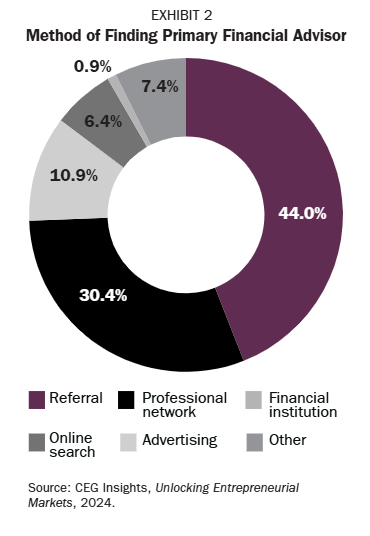
The upshot: It seems clear that the entrepreneurial community values a strong reputation and personal endorsement in their financial advisory relationships—suggesting that in high-stakes finance, the personal touch and credibility reign supreme. This tendency is particularly prevalent among business owners with a net worth of $5 million or more. Such entrepreneurs actively favor advisors recommended by their peers or those vetted through their professional circles, underscoring the critical role of trust and proven expertise in their selection process.
Of course, there is no “perfect” way to find advisors. For example, online research may not be a common approach—but that doesn’t mean it’s automatically a poor route to take. Going forward, ask yourself these questions:
- How do your methods of identifying high-quality advisors line up with the methods used by the majority of other entrepreneurs?
- Do you feel your approach to finding advisors is optimal, based on the professionals you have met?
- How comfortable do you feel going to your industry peers or other close personal or business relationships and asking them for referrals to high-quality advisors?
- Does your network include an adequate number of people who you feel know and work with top professionals who may be helpful in your endeavors?
The role of advisors in entrepreneurs’ lives
It may be especially helpful to see some ways in which other successful entrepreneurs look to (even rely on) financial advisors for insights, guidance and solutions.
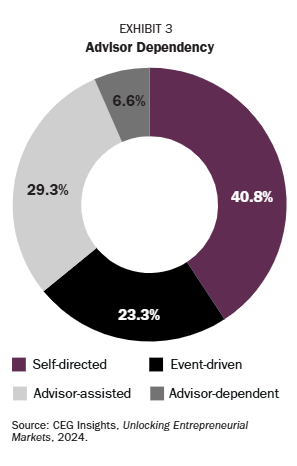
Overall, the extent to which business owners depend on advisors varies significantly, as you might assume. For example, most entrepreneurs surveyed labeled themselves as “self-directed.” That means they tend to make most financial decisions themselves while periodically consulting with advisors—to test and validate their decision or to see if they’re overlooking important insights. These individuals often look to advisors mainly for specialized expertise and analysis, or as a sounding board for their ideas.
In the entrepreneurial landscape, 40.8% perceive themselves as self-directed—indicating a preference for autonomy in decision-making (see Exhibit 3). That’s not surprising, given their position as business owners.
Nonetheless, 29.3% prefer an advisor-assisted approach—leaning on professional guidance for financial strategies. Nearly a quarter (23.3%) of entrepreneurs are event-driven, suggesting specific life events or business milestones influence their financial decisions. Only a tiny fraction (6.6%) identify as fully advisor-dependent and rely heavily or even entirely on their advisors for financial direction.
What’s more, when it comes to working with their advisors, the majority of entrepreneurs—56.9%—prefer one advisor for advice on both their personal and business needs (see Exhibit 4). In short, business owners generally seek a unified financial approach rather than a group of disparate professionals. A much smaller, but significant, percentage of entrepreneurs (30.9%) prefer different advisors for business and personal needs.
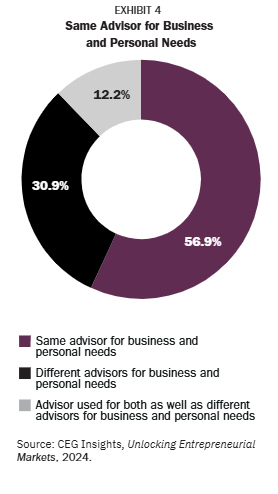
The biggest reason for using one advisor: It helps the entrepreneurs align their goals (35.5%). Efficiency and improved communication were other reasons given. Meanwhile, the most cited reason for using different advisors: It allows the entrepreneurs to gain more specialization (34.1%). They also like the diversity of using multiple advisors and see this preference as enabling them to have a more tailored approach to their finances.
Consider your own situation as you review these findings.
- Do you prefer your advisors to serve as a sounding board for your own ideas, or would you rather rely heavily on advisors for strategies and implementation?
- Does it make sense to have one advisor address both your professional financial needs and your personal wealth goals?
Conclusion
The financial advice you receive has the potential to impact your success and net worth significantly. Knowing how other business owners view the role of financial advisors in their lives may help provide important clarity about your own preferences when it comes to your relationships with such advisors. Armed with a clear picture of what you want and don’t want, you can take steps to ensure you’re getting the help that feels right to you.
VFO Inner Circle Special Report
By John J. Bowen Jr.
© Copyright 2026 by AES Nation, LLC. All rights reserved.
No part of this publication may be reproduced or retransmitted in any form or by any means, including but not limited to electronic, mechanical, photocopying, recording or any information storage retrieval system, without the prior written permission of the publisher. Unauthorized copying may subject violators to criminal penalties as well as liabilities for substantial monetary damages up to $100,000 per infringement, costs and attorneys’ fees.
This publication should not be utilized as a substitute for professional advice in specific situations. If legal, medical, accounting, financial, consulting, coaching or other professional advice is required, the services of the appropriate professional should be sought. Neither the author nor the publisher may be held liable in any way for any interpretation or use of the information in this publication.
The author will make recommendations for solutions for you to explore that are not his own. Any recommendation is always based on the author’s research and experience.
The information contained herein is accurate to the best of the publisher’s and author’s knowledge; however, the publisher and author can accept no responsibility for the accuracy or completeness of such information or for loss or damage caused by any use thereof.
Nathan Brinkman is a registered representative and offers securities and investment advisory services through MML Investors Services, LLC. Member SIPC (www.sipc.org) Supervisory office: 8888 Keystone Crossing #1600, Indianapolis, IN 46240 (317) 469-9999. Triumph Wealth Management, LLC is not a subsidiary or affiliate of MML Investors Services, LLC or its affiliated companies. Nathan Brinkman: CA Insurance License #0C27168 CRN202908-11385628