


Key Takeaways
- Strong relationships with others are a key part of how most people define success, personally and professionally.
- Results-driven relationships involve understanding each party’s self-interests.
- Look for areas of alignment—that’s enlightened self- interest.
The levels of fulfillment and contentedness we feel in our lives are often tied closely to the quality of our relationships—the amount of connectedness we have with other people around us.
But that same type of connectedness may be an instrumental part in determining how much success—professional and personal—we achieve.
Consider, for example, one group of people who tend to be superior at generating millions (sometimes even billions) of dollars in net worth: entrepreneurs.
In nearly all the cases we have seen, business owners’ accomplishments can be traced back to their business relationships. Yes, some entrepreneurs have industry-disrupting ideas. And sure, some entrepreneurs’ sheer brilliance outweighs everything else. However, in working closely with highly successful ultra-wealthy entrepreneurs over two decades, we have discovered that their accomplishments can largely be credited to the quality of their business relationships.
We observe a similar dynamic among non-entrepreneurs, too. Individuals and families who achieve their goals—big and small—tend to do so in large part due to the connections they have developed with other people both personally and professionally.
Here again, a handful of people might be able to do it all themselves. And some people will simply climb over others to grab their brass ring. But overall, we find that it’s the relationships that power the results.
The good news is that there is a process that virtually anyone can use to connect with others to build productive relationships, enhance them over time and optimize them so that everyone who is part of the relationship comes away from a given situation feeling like a winner—and feeling motivated to work together again in the future.
Here’s how to start making it happen.
A four-step process
Close relationships are a key component of success for many people. CEG Insights research* found that when asked to define what personal success meant to them, affluent investors chose “having close relationships with family and friends” over all other answers—including “having financial security.”
Likewise, when asked to define professional success, the second-most-common response (after “feeling fulfilled by work”) was “being respected and respecting colleagues and peers.” What’s more, the wealthier the respondent, the more likely they were to give that answer.
Developing and enhancing connections that are specifically made to get results involves a concerted effort to understand another person’s self-interests deeply, so that you can determine whether they share some or all of your own self-interests. If you can identify such alignment, you can start to craft a relationship where each of you can benefit by helping the other person get what he or she wants.
For example, say you do contract work for a midsize company. You want more work and more money from that company, while the company wants to keep growing. By building a deep relationship with the
business owners, you will do more work for them—helping them grow. As they expand and need more work done, they’ll look to you for help with the additional projects—and potentially pay you more over time.
A four-step process can help you execute on this aligned-self-interests approach (see Exhibit 1).

Step 1: Identify your self-interests
You must start by being very clear about your most important goals, issues and concerns. You need to know what “winning” in a given situation or environment means to you—what those outcomes look like in detail. Armed with that clarity, you can determine what you are looking for from your relationships—which, in turn, will enable you to identify areas of direct alignment or ways to deliver value.
Step 2: Understand their self-interests
Identifying what the other person or persons want and need is a key step in building connection. Determining what’s extremely important (as well as what is not important) to someone else can be very easy if they’re willing to open up to you. That said, this can be challenging when the other people aren’t forthcoming. For example, it’s quite common for entrepreneurs and high-level executives to hide their goals and objectives from those they see as “the other side.”
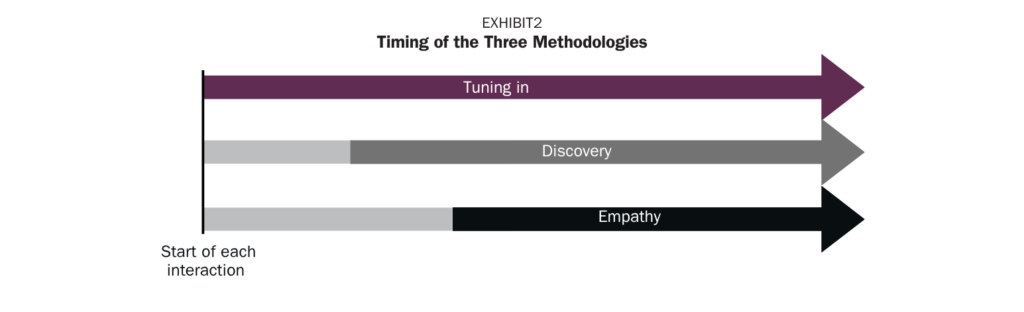
People who are truly great at forging productive connections are generally adept at unearthing what is positively meaningful (e.g., aspirations) and negatively meaningful (e.g., fears) to the people they’re dealing with. Typically, they accomplish this by employing three related methodologies that work together:
- Tuning in. You need to convey by your presence that you’re interested and concerned. Listen—and look them in the eyes when you do. Be authentic.
- Discovery. You cannot give to get until you artfully use questions and probes to get insight into what really matters as well as what causes them concern.
- Empathy. Empathy is intertwined with discovery. You need to sincerely understand other people from their vantage point and know what it’s like to “walk in their shoes.” You also need to make sure they understand that you possess this deep insight about them.
Once you start a conversation with someone you want to connect with for results, you should use all three methodologies (see Exhibit 2). You will tune in and engage in discovery. As you collect information, you will employ empathy to determine whether you are interpreting the information correctly and to communicate to those involved that you understand them.
Step 3: Appeal to their self-interests
There are two basic approaches you can take to help other people achieve their self- interests: direct alignment and added value.
With direct alignment, as noted above, you concentrate on the overlap between your self-interests and the self-interests of those with whom you are dealing. The more overlap that exists and the more your respective actions further your shared goals, the easier it is to reach agreement and move forward to pursue mutual success by supporting each other. We refer to this as ensuring everybody’s enlightened self- interests.
Delivering added value is an approach to use when you determine there is little to no direct alignment of interests. In these instances, you use your capabilities, insights and connections to help other people achieve goals and agendas that differ from or are not directly connected to yours. This enables you to tap into the so-called law of reciprocity. More a social norm than an actual law, it’s that internal pressure that causes people to want to help those who have helped them in the past.
Important:
Appealing to people’s self-interests isn’t about trying to persuade or convince them that an opportunity exists or that you can substantially help them achieve their agendas. It’s about accentuating the opportunities for success that actually do exist in a situation. It’s about making determined efforts to help other people accomplish their objectives.
Step 4: Track results
When you track results, you can accelerate your success. Highly successful people in all areas of life may value good intentions, but they want to see those intentions accompanied by good results. Good intentions without meaningful results are ultimately just nice thoughts—and nice thoughts don’t create highly successful companies or build significant personal wealth.
The only way you will know if your actions have helped others achieve their self-interests is if you track results. Likewise, you need to track results to see if your efforts to help others have translated into their helping you attain better outcomes for you.
By tracking results—yours and those of people in your relationships—you can determine where to best focus your efforts to maximize your future success. For example, you might decide to optimize other business relationships. You might choose to refine the added value you’re providing to a peer. It all depends on how the situations are playing out—and, of course, you can’t know how they’re playing out if you’re not paying attention.
Conclusion
Ultimately, this process is aimed at empowering you to help other people reach their goals so they’ll help you achieve yours. By harnessing the concepts of enlightened self-interest and added value, you can change the entire game by creating significant business possibilities for everyone.
What’s more, you can create these types of connections with practically anyone—in a wide variety of professional and personal situations. Help other people get what they seek and you’ll find them taking actions that will make you a winner as you define it.
So for every person with whom you want to enhance or optimize the connection and the relationship, ask yourself if you really understand their self-interests. Then explore how you can help them achieve their self-interests so that they’ll in turn help you.
VFO Inner Circle Special Report
By John J. Bowen Jr.
© Copyright 2026 by AES Nation, LLC. All rights reserved.
No part of this publication may be reproduced or retransmitted in any form or by any means, including but not limited to electronic, mechanical, photocopying, recording or any information storage retrieval system, without the prior written permission of the publisher. Unauthorized copying may subject violators to criminal penalties as well as liabilities for substantial monetary damages up to $100,000 per infringement, costs and attorneys’ fees.
This publication should not be utilized as a substitute for professional advice in specific situations. If legal, medical, accounting, financial, consulting, coaching or other professional advice is required, the services of the appropriate professional should be sought. Neither the author nor the publisher may be held liable in any way for any interpretation or use of the information in this publication.
The author will make recommendations for solutions for you to explore that are not his own. Any recommendation is always based on the author’s research and experience.
The information contained herein is accurate to the best of the publisher’s and the author’s knowledge; however, the publisher and the author can accept no responsibility for the accuracy or completeness of such information or for loss or damage caused by any use thereof.
Nathan Brinkman is a registered representative and offers securities and investment advisory services through MML Investors Services, LLC. Member SIPC (www.sipc.org) Supervisory office: 8888 Keystone Crossing #1600, Indianapolis, IN 46240 (317) 469-9999. Triumph Wealth Management, LLC is not a subsidiary or affiliate of MML Investors Services, LLC or its affiliated companies. Nathan Brinkman: CA Insurance License #0C27168 CRN202908-11241908